
Platform strategy & book-to-screen development · Brief 002
Instagram Goes Long. Your Book Could Be the Next Show.
Instagram is stepping into YouTube’s long-form arena. For authors and rights holders, the next move starts with a screenplay worth watching.
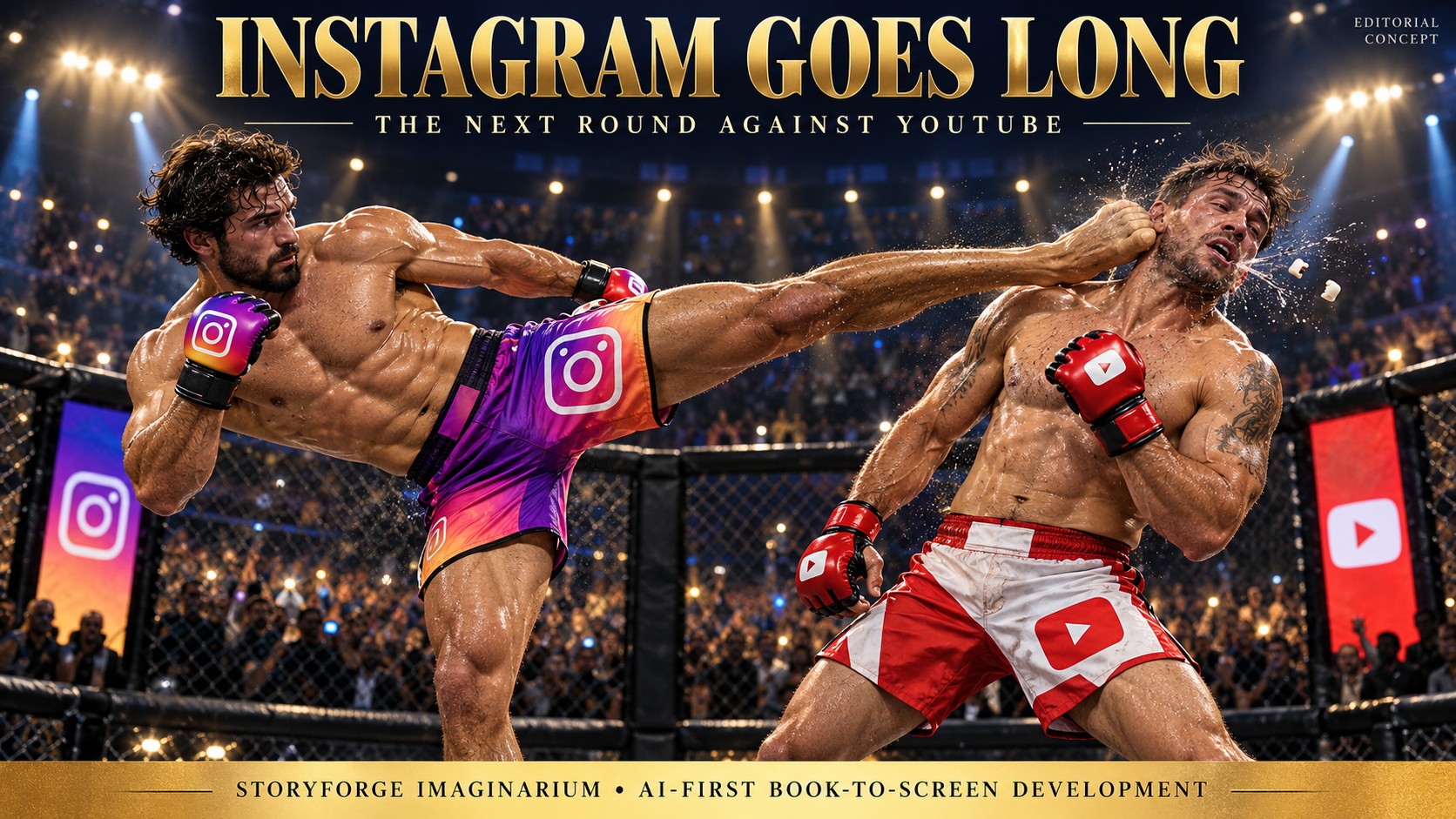
The platforms are fighting for the next hour of your audience’s attention. My interest is in what fills that hour: a character under pressure, a scene that turns, and a story that earns the next episode.
For an author sitting on a book readers already love, this is a reason to develop a screen strategy. Storyforge Imaginarium brings screenplay adaptation, character development, cinematic visualization, and AI-first production into one collaborative process.
The news: a longer runway for storytelling
On October 26, 2026, Instagram announced a test of Features: horizontal videos up to 90 minutes, expanding from an initial Brazil test to selected U.S. creators. It is also testing links from up to eight short clips into a full video. This gives eligible creators a potential path from a discovery clip to longer viewing within the same platform. TheWrap’s October 26 report details the announcement.
That is a distribution experiment, not an open invitation for every account to upload a feature film. Access and terms need to be checked before planning a release. The announcement’s early examples include podcasts and comedy; a new wave of scripted adaptations is our creative opportunity, not an announced Instagram commissioning program.
More runtime creates room. Direction makes it matter.
A novel can live inside a character’s thoughts for pages. A screenplay has to make that conflict visible. I want the audience to read the choice in the blocking, hear the hesitation before a line, and feel the cost when the scene ends.
That is why we start with adaptation. We find the dramatic spine, choose a feature or episodic format, and decide which events belong on screen. A bestselling book offers an existing story and readership; it still needs a screen language of its own.
From the manuscript to the first take
- Adapt the story. Build a treatment and screenplay around the central conflict. Compress where needed and protect the emotional turns readers care about.
- Make the character bible. Define wants, contradictions, relationships, voice, and approved visual references. Continuity starts before generation.
- Build the show universe. Establish the world’s rules, season arcs, recurring locations, and episode engine so the pilot promises a series that can sustain itself.
- Direct a selected scene. Test performance, framing, sound, and pacing in a cinematic proof of concept. A tight 85mm close-up and a held reaction might land a moment better than another spectacle shot.
- Design discovery into delivery. Plan a landscape master and deliberate vertical excerpts. Each clip should present a compelling question that the full scene or episode actually answers.
The author stays involved through clear review milestones. We refine the treatment, characters, script, and selected imagery together before committing to more finished runtime. Approved creative decisions become reusable production references.
AI-first production opens the location book
A fully generated sequence lets us explore a distant planet, an impossible city, or a period setting without putting a physical camera crew on location. There is no on-set location permit, cast travel itinerary, or lighting truck for that generated shot. Revisions can return to the scene rather than require a conventional reshoot.
There is still real production work: writing, directing performances, controlling character consistency, selecting takes, editing, voice, sound design, and finishing. AI makes ambitious imagery more accessible; the creative judgment is what brings a scene into the can.
At Storyforge, our ambition is to lead AI-first storytelling through finished work and a disciplined development process. Hollywood Quality. Silicon Valley Speed. is the standard we work toward with authors, publishers, and production partners.
Build the asset before betting on a platform
Instagram’s economic proposition is still developing. TheWrap’s October 27 analysis reports unresolved questions about creator ad revenue sharing. More potential reach does not establish a production budget or guarantee payment.
My recommendation is to develop a strong, portable story package: script, character references, a selected scene, and pitch assets. Use those materials to pursue a funded pilot, a paid production engagement, or a distribution conversation. Keep the core asset useful across platforms instead of building a whole season around one test feature.
Your book deserves a screen plan.
Storyforge works with authors, publishers, and authorized rights holders on screenplay adaptations, pilots, character bibles, universe bibles, concept trailers, and cinematic sequences.
Start with a paid development phase: an adaptation treatment, an agreed script excerpt, and a scoped visual proof of concept. We agree on fees, rights, deliverables, review rounds, and timing before work begins. Further production follows the approved plan.
Discuss Your Book with JeffExplore book-to-screen development · Watch the Fourth Watch promotional trailer
Sources & reporting
- The Dailies, “Instagram Goes Long,” October 28, 2026 — the news prompt for this original director’s perspective.
- TheWrap, October 26, 2026 — test scope and video format.
- TheWrap, October 27, 2026 — competitive context and monetization questions.
Platform facts checked October 29, 2026. Creative recommendations are Jeff Jones’s analysis. No platform partnership, placement, audience result, or revenue is promised.