
The AI Showrunner — Director’s Brief
Your Next VFX Shot Shouldn’t Start With a Six-Week Pipeline
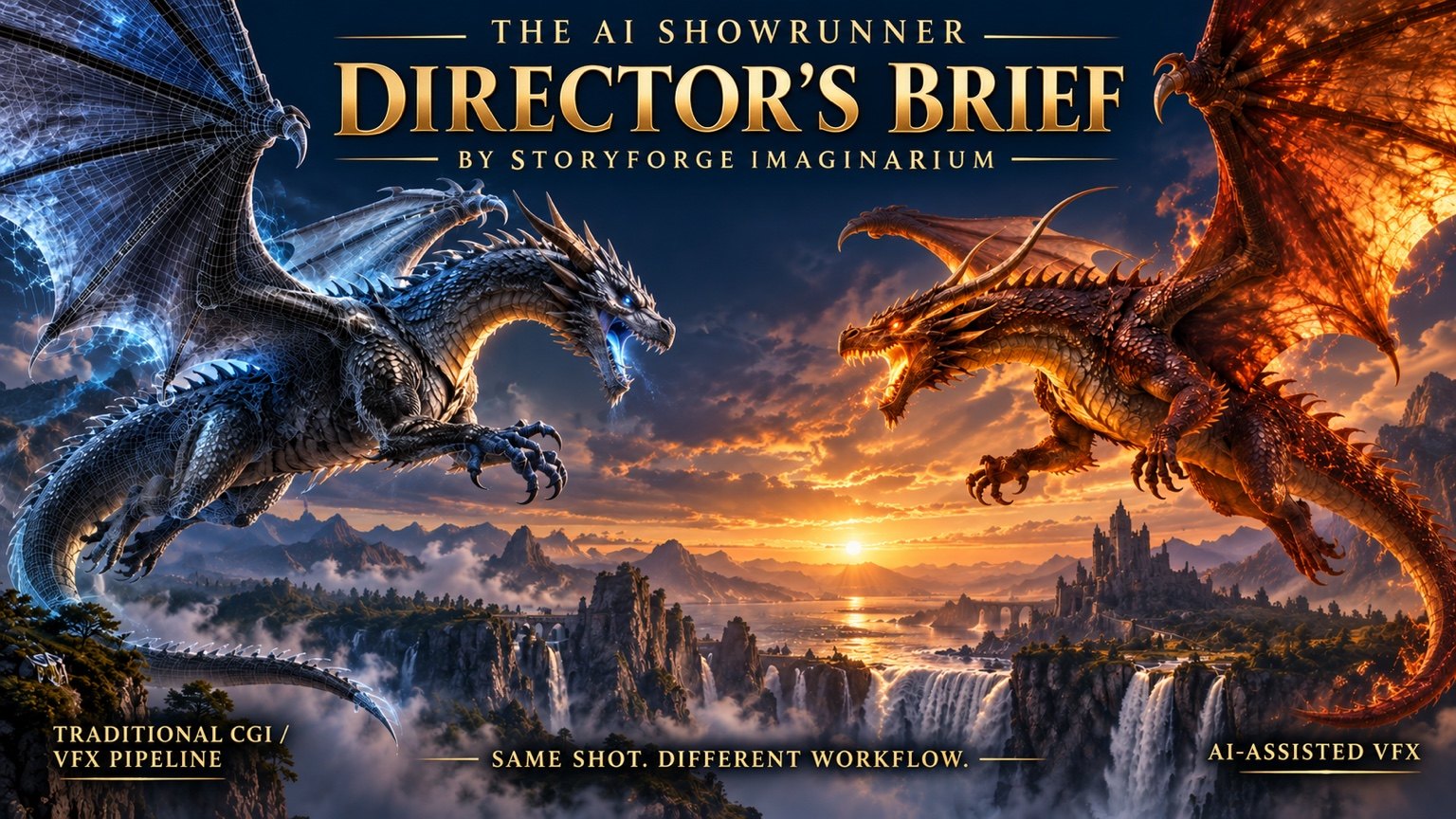
A dragon clears a waterfall. A rider holds on. Water, atmosphere, scale, and camera movement either sell the moment—or expose the machinery.
The audience experiences a shot. The producer pays for the process behind it.
That distinction matters when comparing conventional visual effects with generative production. Modeling, surfacing, rigging, animation, simulation, lighting, rendering, and compositing can deliver extraordinary control. They can also commit substantial resources before a director knows whether the scene belongs in the film.
AI-first development changes when that commitment becomes necessary.
What the traditional VFX pipeline builds
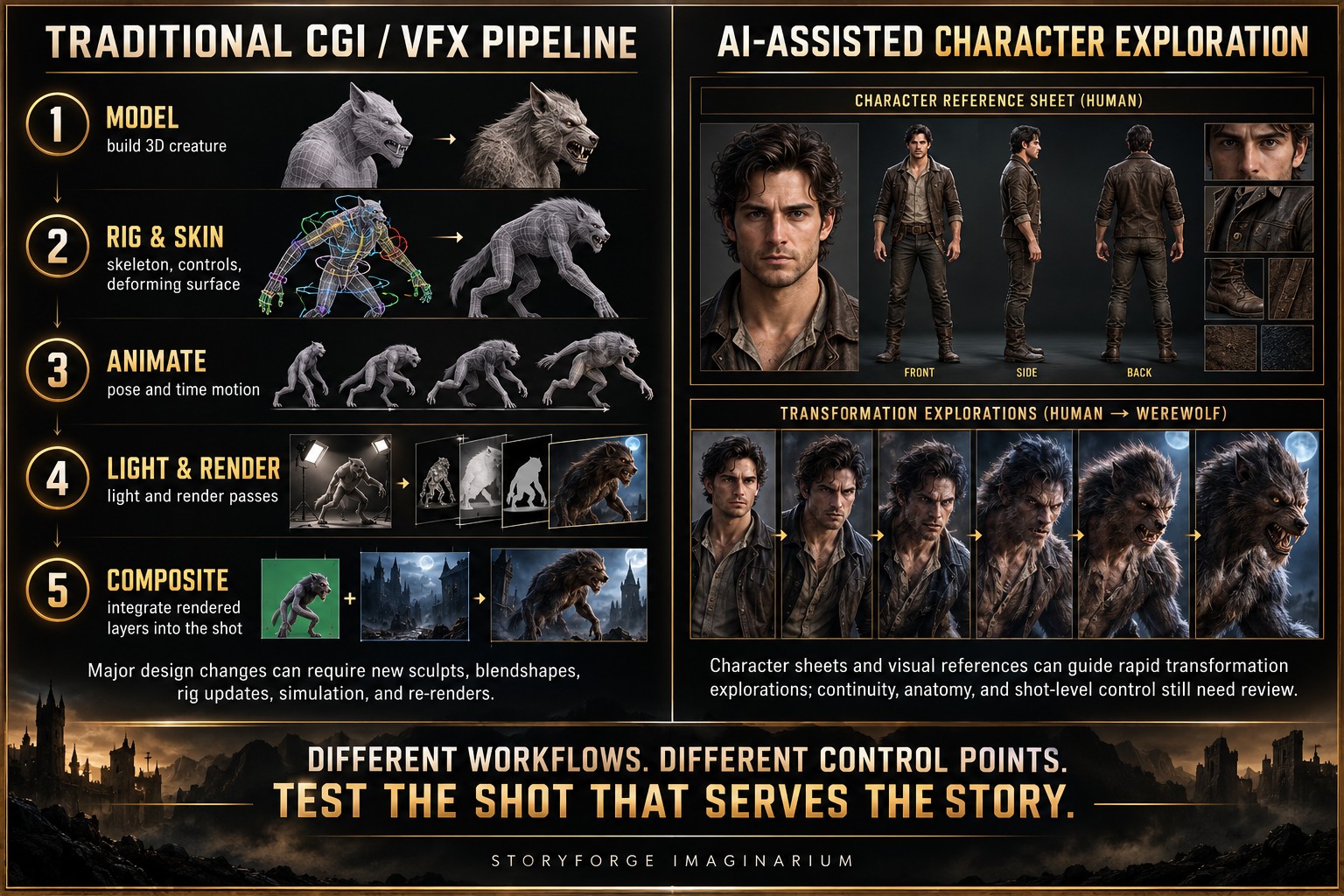
A conventional creature shot can involve a chain of specialized assets and departments. The reference below maps the common path from a 3D model through rigging and skinning, animation, lighting and rendering, and compositing. The exact handoffs vary by production, but each stage adds control—and potential revision work.
Character transformation: build the change or explore it
A CG character can absolutely transform. For a human-to-werewolf change, a traditional pipeline may use alternate sculpts, blendshapes, rig adjustments, simulation, and carefully animated transitions. That can deliver precise, repeatable control, while adding asset and shot work.
With AI-assisted production, approved character sheets and visual references can guide rapid transformation explorations across frames or shots. The result still needs review for identity continuity, anatomy, motion, and editorial control. The two approaches offer different control points and tradeoffs.
Example: the werewolf transformation in The Last Werewolf
This short demonstrates an AI-generated transformation workflow. Every character and scene in the film was generated with AI; no actors were filmed, and no live-action scenes were shot on camera.
Watch The Last Werewolf on YouTube.
Watch the comparison before accepting the verdict
Higgsfield’s dragon challenge puts generative video alongside ErikDoesVFX’s conventional work. Watch both creators’ breakdowns. Examine the fall, the creature’s movement, the rider’s scale, and the interaction with water.
Watch Higgsfield’s AI vs. traditional VFX challenge and watch ErikDoesVFX’s dragon sequence and breakdown.
The useful question is not which production method deserves loyalty. It is which version serves the scene—and how much effort is required to reach an approved result.
These demonstrations are compelling evidence that studios should test generative approaches. They do not establish that every AI shot beats every conventional shot.
Buy creative certainty before production complexity
For a producer, the first deliverable may be a decision: does the creature reveal work? Does this camera move improve the action? Can the emotional beat survive a shorter runtime?
Storyforge Imaginarium helps make those decisions visible through scripts, approved character references, cinematic concept trailers, and selected sequences.
A paid, defined-scope sequence can establish the visual direction before a larger production commitment. Review it for character continuity, physical credibility, editorial usefulness, and revision effort—not merely the attractiveness of one frame.
From the first idea to the finished story
Our development approach connects the work: an initial concept becomes a treatment, screenplay, character bible, and show-universe bible. Approved references guide visual production, voice, sound beds, original music, and the edit.
Books and audiobook adaptations can be scoped alongside screen development. Final delivery can include a 4K master and, where agreed, DCP preparation and quality checks against the receiving venue’s specifications. Creating a DCP is a delivery service; securing theatrical distribution is a separate undertaking.
Bring us the sequence you have been postponing
A world that felt too expensive. A trailer that needs one impossible moment. A manuscript whose strongest scene has never left the page.
Let’s define a paid first phase, establish the creative target, and put something reviewable on screen.
Storyforge Imaginarium — Hollywood Quality. Silicon Valley Speed.