
Development · AI-first studios · Production decisions
Before You Spend Millions, Put the Movie on Screen
Why AI-First Film Studios Belong in Development, Production, and Post
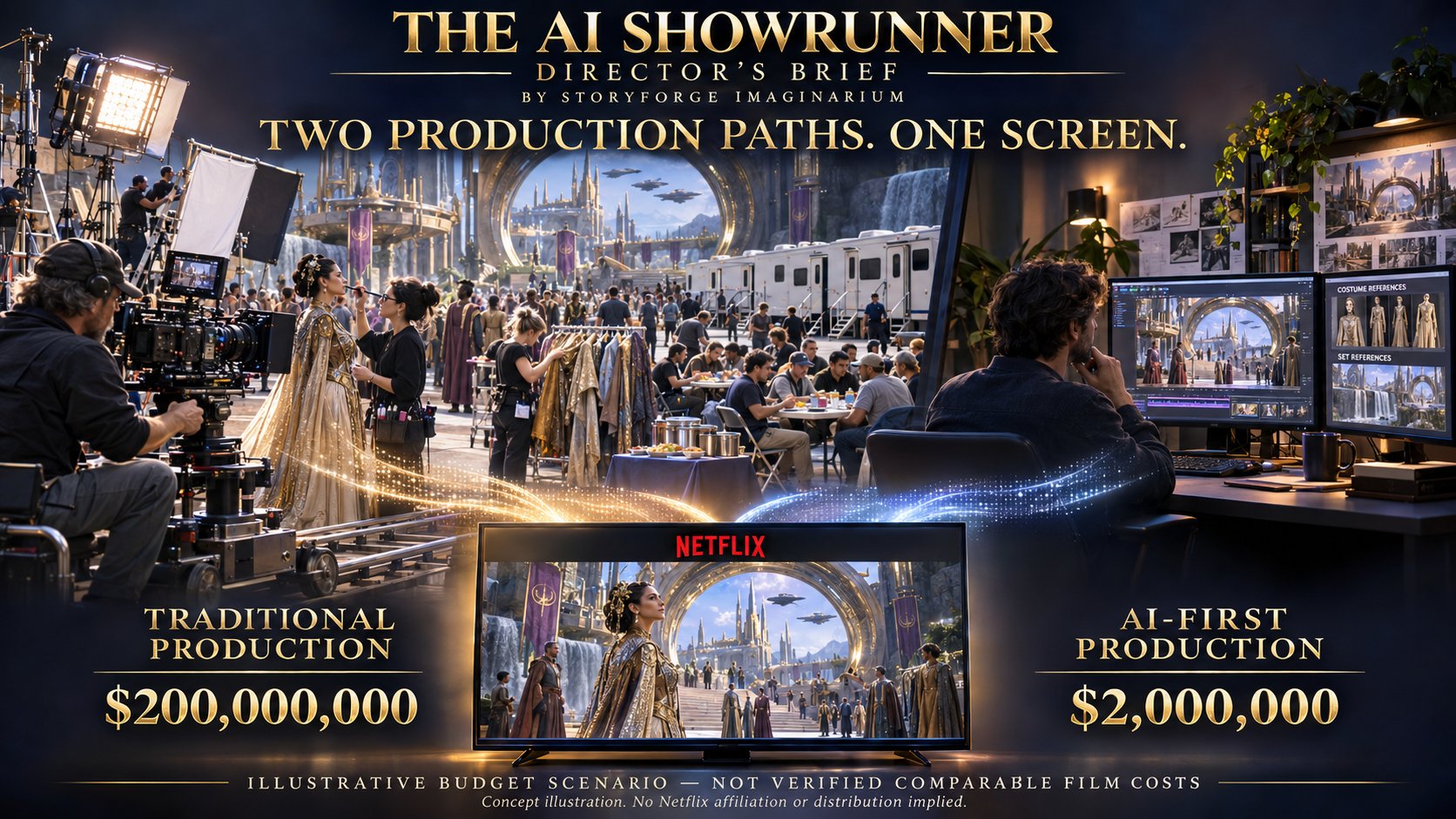
A producer should not have to mount a full production just to discover whether an ambitious scene works.
Before the location is booked, before the cast travels, before a creature moves from modeling to rigging, we can put a version of that idea on screen. We can examine the blocking, the atmosphere, the costume silhouette, the camera movement, and—most importantly—the emotional turn.
That is the practical opportunity of an AI-first film studio. It gives the creative team something concrete to direct before the largest commitments are made.
Make the pitch visible before asking for the green light
A screenplay tells us what happens. A strong proof of concept helps us feel how it happens.
Does the reveal land? Does the location communicate scale? Is the protagonist’s hesitation readable in close-up? Does the sound bed build dread or simply announce it?
For an author, producer, or rights holder, a short cinematic sequence can bring those questions into a development meeting. It can support a pitch, explore an adaptation’s tone, or expose a weak scene while revisions are still manageable. It does not guarantee financing. It makes the creative conversation more specific.
At Storyforge, the starting point is the story—not a random collection of impressive shots. We develop the character motivations, emotional arcs, visual references, and world rules that allow a sequence to belong to a larger film or series.
Fewer handoffs can change the economics of iteration
A conventional creature shot may involve modeling, surfacing, rigging, animation, effects simulation, lighting, rendering, and compositing. On a larger production, specialist departments coordinate those stages. A change to anatomy or motion can create downstream work.
Generative video offers another route. Some shots can be created without a separately built 3D mesh, skeletal rig, or simulated environment. The director can work from approved reference images and motion instructions, generate alternatives, and carry selected takes into editorial.
That can consolidate stages and shorten the distance between a creative note and a new visual option. It does not make every revision a one-prompt operation. Changing a costume can disturb a face; changing a camera move can alter geography. Reference management, shot selection, continuity checks, editing, and sometimes compositing remain essential.
The production question is not whether a prompt exists. It is whether the workflow delivers the required shot, survives notes, and fits the schedule.
Major studios are moving beyond the experiment
Studio adoption is already documented. On September 18, 2024, Lionsgate and Runway announced a partnership centered on a custom model trained on Lionsgate’s proprietary portfolio. On June 11, 2026, they announced an expansion: Lionsgate had taken an equity interest, and the companies planned joint IP development, beginning with a short-form episodic series. That is an announced program, not proof that every planned project has shipped. [1][2]
Netflix has also reported practical use. In July 2025, it described using generative AI for a building-collapse sequence in The Eternaut, saying the sequence was completed ten times faster than a traditional VFX approach. That is Netflix’s comparison for one sequence—not a tenfold speed guarantee for an entire film. [3]
These examples challenge the idea that AI filmmaking belongs outside professional production. Established studios are evaluating where it helps their filmmakers.
Creative access is changing—and the objections deserve precision
Lowering the cost of visual experimentation gives smaller studios more room to compete. An independent team can explore a vast set or elaborate costume without physically building it first. That challenges established assumptions about who can afford spectacle.
It is reasonable to examine how incumbents respond when production becomes more accessible. It is not reasonable to assume every objection is turf protection. Consent, copyright, compensation, performance control, and dependable delivery are substantive issues. A professional AI-first studio should be able to discuss them clearly.
Our strongest answer is finished work supported by an accountable process: approved references, authorized materials, documented revisions, and a clear creative lead.
Two hundred million versus two million: a scenario, not a promise
The accompanying graphic imagines a $200 million traditional production beside a $2 million AI-first production. Those are illustrative budgets, not verified costs for equivalent movies. They are not a Storyforge quotation or evidence of a Netflix deal.
An AI-first budget still needs writing, direction, production management, generation, editorial, sound, music, quality control, finishing, and delivery. Marketing and distribution are separate commercial commitments. The useful exercise is to scope the actual story and compare credible production plans.
The audience receives the finished film
At delivery, both camera-originated and generated images can become digital picture and sound. But sharing a delivery format does not make two films equal in quality.
What matters on screen is performance, intention, continuity, pacing, and emotional impact. A spectacular world is only useful if the audience cares what happens inside it.
Storyforge Imaginarium brings development and visualization into a collaborative process: screenplay adaptation, character and universe bibles, concept sequences, trailers, music, sound, and editorial. Finishing specifications—including a 4K master or theatrical DCP—must be agreed and quality-checked for the project. Creating a DCP does not secure theatrical bookings.
Bring one scene that feels too expensive to explore. We’ll define a paid proof of concept with clear deliverables, review milestones, and a production plan before work begins.
Discuss your project with Jeff · Explore Storyforge
Evidence and sources
- Lionsgate: Runway partnership announcement, September 18, 2024
- Runway: partnership expansion, June 11, 2026 — company announcement; planned projects are distinguished from completed releases.
- Reuters: Netflix’s reported use of generative AI in The Eternaut, July 18, 2025 — reports Netflix’s sequence-specific speed comparison.