
The AI Showrunner — Director’s Brief
Fourth Watch: Which Shot Do You Need to See in the Cut?
The Fourth Watch trailer uses a cold grade for the North Dakota oil fields and ranch-drama camera references from Yellowstone. It shows the kind of look your team can ask Storyforge to match before committing to a larger build.
Watch the Fourth Watch trailer on YouTube
The camera reference behind the look
Cinematographer Ben Richardson said his Yellowstone team used the ARRI ALEXA Mini and AMIRA, recording 3.2K ProRes 4444. He described keeping the camera back and using longer lenses even for wide frames to preserve the scale of the landscape. The production carried ARRI/ZEISS Ultra Primes and Angénieux zooms. Read Richardson’s camera and lens interview in Film and Digital Times.
For Fourth Watch, that ranch cinematography was the reference. The North Dakota brief called for colder color, and the trailer applies that cool treatment to the oil-field setting. A camera name in a prompt gives the shot a direction. Focal length, camera distance, focus falloff, lighting, and a graded reference give the team more specific points to match. The trailer illustrates that look. Camera and lens references describe the intended appearance of the generated frames.
Match your approved production references
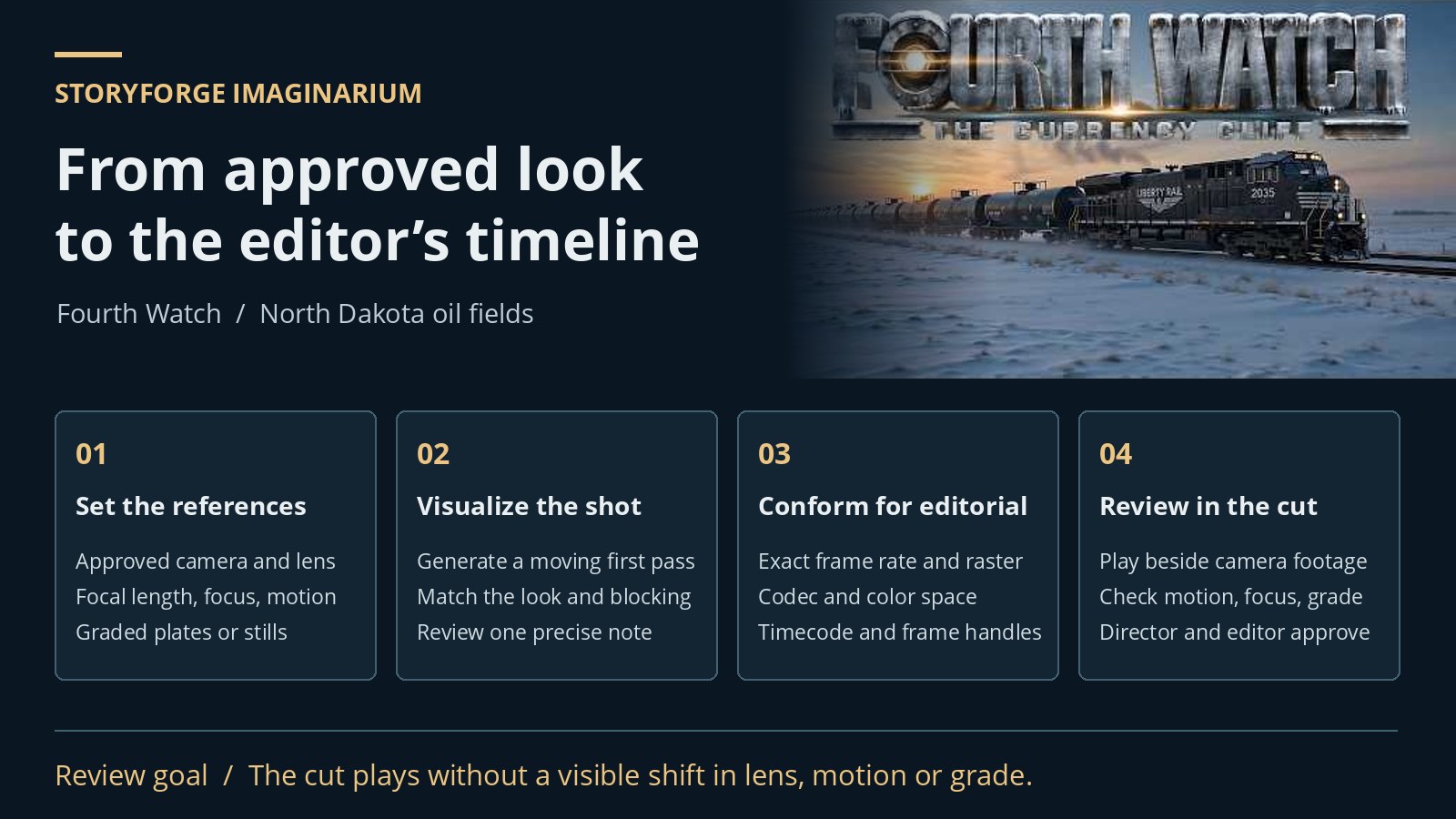
Send the approved camera body and sensor mode, lens series and focal length, aperture, focus distance, shutter angle, and camera movement. Include a cleared plate, neighboring shot, or graded still when available. The DP can point out what must carry through the cut, from depth of field and highlight roll-off to shadow color, grain, and motion blur. The colorist can specify the input, working, and output color spaces and identify the approved LUT or CDL and when to apply it.
Storyforge can rapidly generate a first pass against that brief. Give us one note, such as holding the frame and focus while cooling the shadows. We’ll bring the revision back for review so the director can see what changed and what held.
Deliver the shot for the editor’s timeline
We agree on the exact delivery frame rate, raster, aspect ratio, codec, color space, timecode, and frame handles before export. Those are verifiable delivery specs. We check motion cadence after conforming and keep the generated shot’s provenance clear. If a deliverable requires camera originals, specify that in the brief.
The visual test happens in the edit. Place the generated insert between the physical-camera shots it needs to match. Play it at normal speed, then inspect the transition with the director, DP, editor, or colorist. The goal is a cut where even the director sees no visible shift attributable to how the insert was made. The team can approve the match or call out exactly where focus, motion, texture, or grade still needs work.
Get the Storyforge Project Video Brief and Delivery Requirements
Bring us one shot
Storyforge Imaginarium is inviting producers, post teams and production partners to propose one five-second shot for a studio-funded case study. A shelved environment, a teaser reveal or an alternate transition can work. For a selected brief, we provide an initial moving concept, one revision, both review clips and a time log at no cost. Your team can review privately and decide whether to request a separate production bid. We agree on approved tools and inputs before receiving project materials. Publishing a partner’s work or naming a production requires its written approval.
We start by asking who will review the clip and what seeing it would help them decide. A sentence is enough to start. What shot would you like to see in the cut, and what decision would seeing it let you make? Email Jeff or book a 15-minute shot review.
Get the AI Showrunner Brief
New articles on AI filmmaking, book-to-screen, and production. No spam — just the brief when something new goes up.