
Director’s field notes · November 11, 2026
Judge the Film, Not the Tool: My Idaho 48-Hour Filmmaking Experience
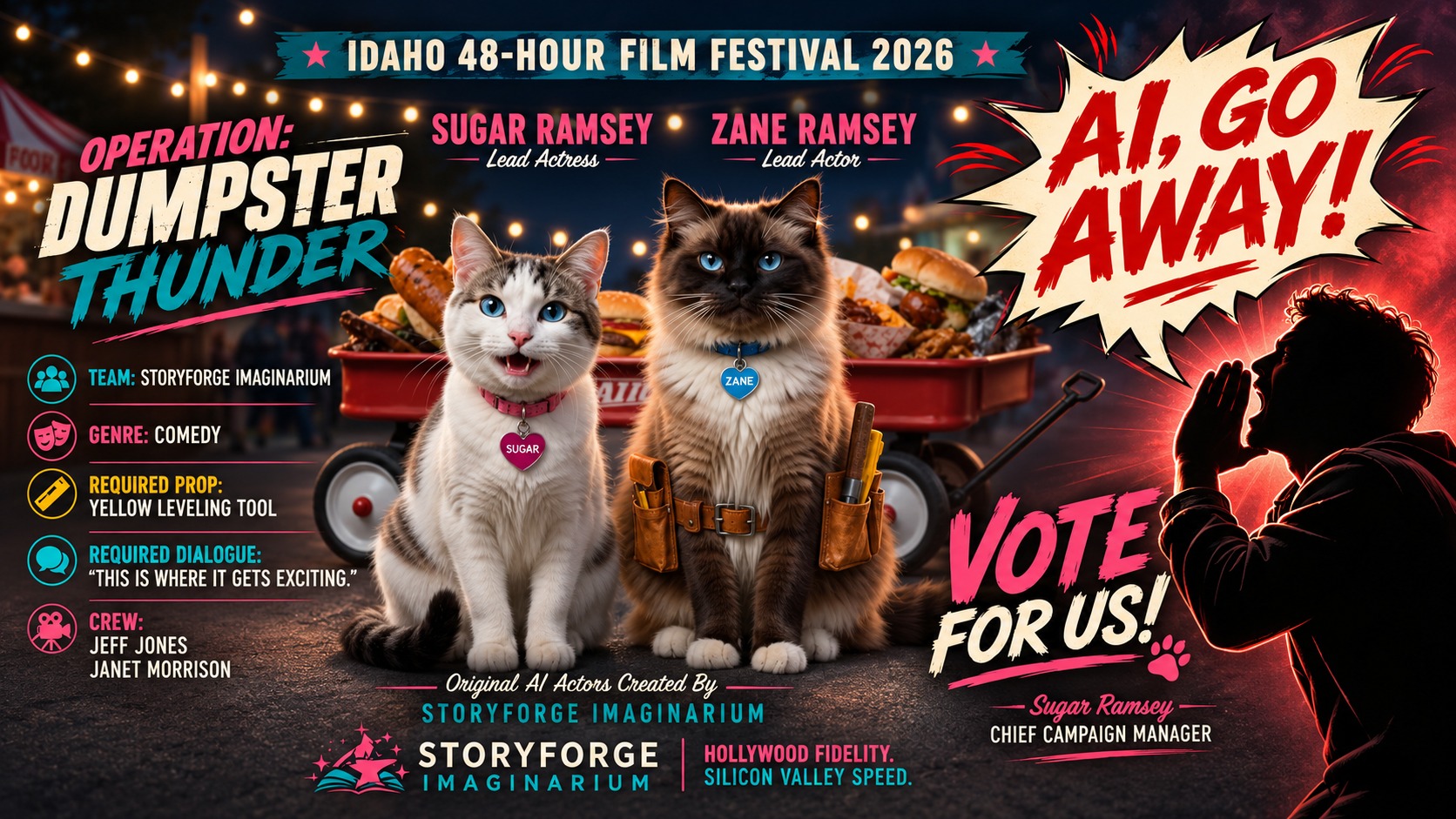
When my film opened at Boise’s Egyptian Theatre, the room was silent. On screen were two animated cats inspired by my own cats—characters I had created after the Idaho 48-hour filmmaking challenge began. I had spent that window building a complete short, and I wanted the audience to give it a chance.
Watch the film first. This 5:56 hybrid short provides the context for the production choices and screening experience discussed below.
Watch on YouTube if the player is unavailable.
Later, I heard boos. I also recall someone shouting, “AI, go away!” That is my recollection of the screening, and it stung. I experienced the response as hostility toward the use of AI. I cannot know what every audience member was thinking. But I can explain what went into the film, and why dismissing a filmmaker because of a tool misses the work.
I wanted science fiction. I got comedy.
I had hoped for science fiction: a chance to build impossible environments and put ambitious effects on a cinema screen. Instead, my assigned genre was comedy. At first, that felt like a handicap. Comedy asks for timing, believable reactions, and a relationship with the audience. Spectacle cannot carry those responsibilities for you.
I briefly wondered whether the assignment reflected people knowing I worked with AI. I have no evidence that it did. The useful question was what I could make with the assignment I actually had.
Effects can absolutely serve comedy. What I needed was a film whose characters and cuts made the absurdity work. My entry, Operation Dumpster Thunder, had to incorporate the assigned elements and stay below six minutes. I delivered a running time of 5:56, deliberately leaving four seconds of breathing room under the limit.
There were real cameras—and real people—in this AI film
Janet and I appear on camera ordering World’s Best Corn Dogs. I went on location at Green Acres Food Truck Park in Boise to film the trucks and their surroundings. I shot with my Insta360 X4 and flew my DJI Mavic Mini. The finished short combined location photography, drone footage, 360-camera material, and generated animation.
Calling it “AI” does not describe every shot or every decision. It was a hybrid production. I chose which moments needed a real location and which could be built through animation. The cats needed recognizable identities and consistent voices. The live-action material needed to belong in the same film. Editing had to connect those different visual languages.
My production account includes a soundtrack running from the opening through the ending, sound design, titles, credits, and a 4K render. Those are not automatic consequences of typing a prompt. They are decisions about how a finished piece should play.
A generated clip is one component of a film
An impressive eight-second shot can be a useful test. It does not, by itself, demonstrate a complete narrative. The same is true of a beautiful camera test. Neither should be asked to stand in for everything a filmmaker can do.
For a finished short, I have to consider what the audience knows, what the character wants, when a reaction lands, how long to hold a shot, and what the next cut changes. Character references help preserve identity. Voice choices help preserve performance. Sound and editing establish continuity across material made in different ways.
That work remains accountable to the audience. If a joke fails, I need to examine the setup, the delivery, and the cut. If a character feels inconsistent, I need to fix it. AI does not excuse weak storytelling. Equally, a weak AI production does not establish that storytelling with AI is impossible.
Criticism is useful. Contempt is not a craft note.
I welcome specific criticism: the scene ran long; the voice changed; the eyeline broke; the joke needed a stronger setup. A filmmaker can act on those observations. Dismissing the entire effort because generated imagery appears on screen gives me nothing to improve.
I also read The Dailies, and I have found some of its AI coverage frustratingly dismissive. That is my judgment of tone, not a claim that every issue attacks AI. Its November 11 issue, for example, covers Disney’s Adobe partnership. The industry is experimenting while the argument about legitimacy continues.
My objection is to turning one disappointing film into a verdict on a whole method. A box-office result alone cannot isolate whether audiences rejected the story, the marketing, the execution, the technology, or some combination. We should ask better questions before declaring the medium finished.
There are serious conversations to have about rights, consent, labor, and creative control. Those deserve specific answers. They do not require treating every independent AI filmmaker as someone who has never written a scene or held a camera.
Watch the work. Then judge the work.
I am proud that I finished a hybrid comedy under a 48-hour deadline and saw it projected at the Egyptian. I am not claiming that using more equipment makes a better film, or that meeting a deadline entitles me to applause. I am asking for the same standard applied to other filmmakers: look at the choices on screen.
At Storyforge Imaginarium, that is also the standard I bring to collaboration. A concept trailer, adaptation, character bible, or cinematic sequence needs a clear purpose and a coherent emotional direction. The tools serve those decisions. They do not replace them.
Watch Operation Dumpster Thunder and decide for yourself. Judge the characters, the timing, the hybrid photography, and the edit. That is a conversation about filmmaking worth having.
Watch Operation Dumpster Thunder
Sources and production context
- The screening experience, production methods, and runtime above are my firsthand account, not independently measured audience research.
- Operation Dumpster Thunder — film supplied by Jeff Jones.
- The Dailies, November 11, 2026.
- Adobe’s November 9, 2026 Disney alliance announcement.
Get the AI Showrunner Brief
New articles on AI filmmaking, book-to-screen, and production. No spam — just the brief when something new goes up.