
The AI Showrunner — Director’s Brief · November 6, 2026
Dracula 2026: How AI-Native VFX Are Rewriting Cinematic Action
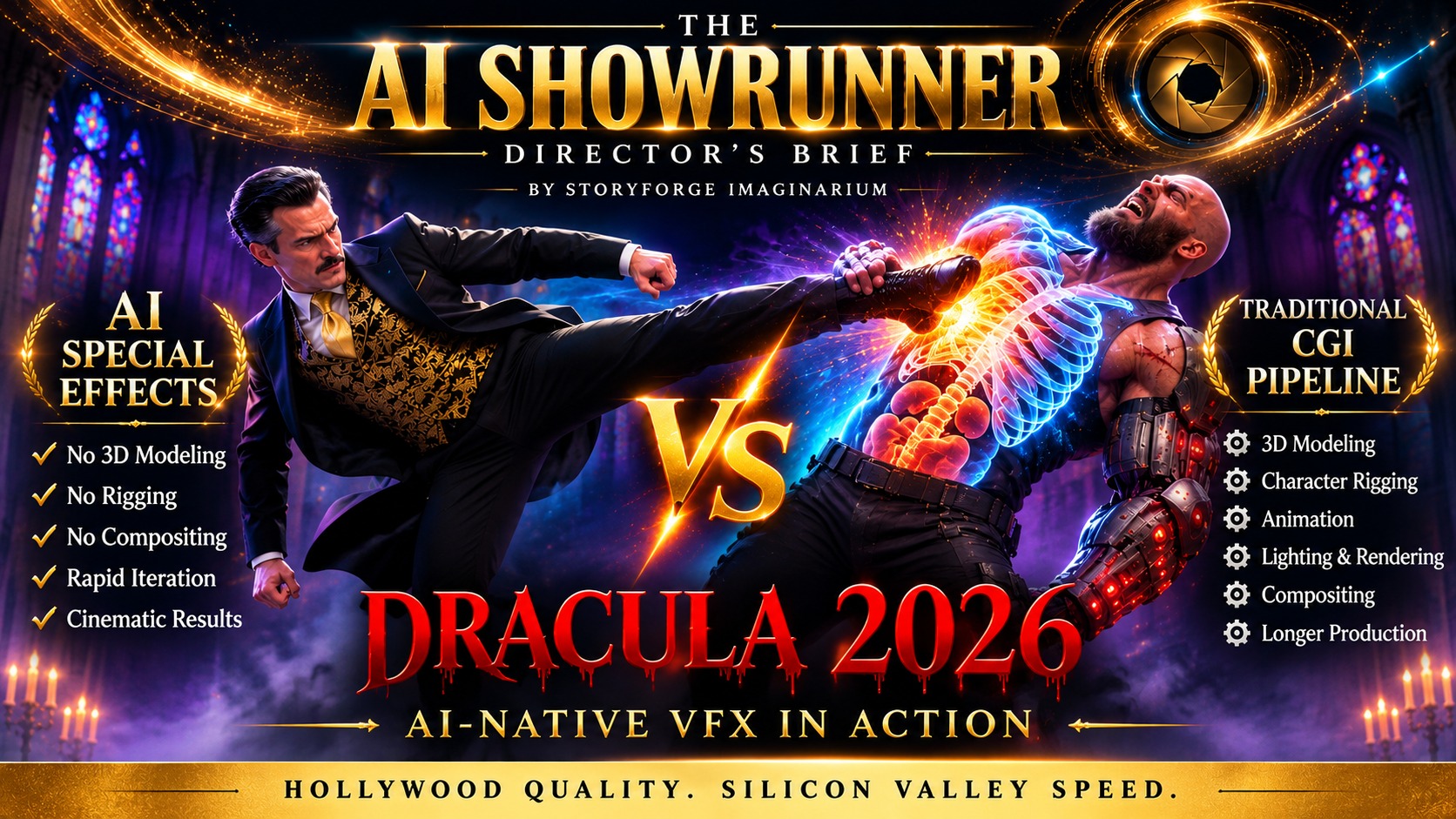
From traditional CGI pipelines to AI-native cinematic effects: what one Halloween film reveals about the changing possibilities of independent filmmaking.
A year can change everything in AI filmmaking
In 2025, building a supernatural fight sequence with generative video often meant working around short shots, inconsistent interactions and limited camera control. A year later, Storyforge Imaginarium revisited Dracula with a more ambitious visual language for its 2026 Halloween special. The completed film runs just over four minutes, and its confrontation with the Butcher of Budapest demonstrates how far AI-first cinematic production has progressed.
The effect is a storytelling decision
Dracula does not need to appear frantic to be terrifying. He remains controlled while his towering opponent struggles to comprehend the speed of an attack. That contrast—the calm predator and the suddenly vulnerable assassin—is what makes bullet-time cinematography meaningful. The audience sees the moment of realization rather than simply a blur of punches.
Inside Dracula Vision
One standout shot changes from ordinary photography into a stylized, translucent anatomical perspective during a kick. The Butcher's glowing skeletal structure and bionic hardware become visible against the Gothic hall, giving the audience a glimpse of Dracula's supernatural perception. This is a fictional cinematic effect, not a medical scan. Its value is how it communicates character and power through the image.
Why this matters for visual effects production
A comparable sequence in a conventional CGI workflow could involve character modeling, rigging, animation, lighting, simulation, rendering and compositing. AI-native video offers another way to explore a finished cinematic result without building every shot from those individual components. Traditional pipelines still have advantages in precise repeatability, technical control and complex revision requirements. The practical opportunity is to choose the pipeline that serves the shot, schedule and budget.
Character continuity is part of directing
The Butcher's facial scar, imposing physique, mechanical right arm and tactical wardrobe make him instantly recognizable. Dracula's black tuxedo and gold waistcoat reinforce the contrast between elegance and violence. Maintaining those identities across different angles, supernatural effects and action beats is a directing challenge—not merely a matter of image quality.
What changed between the 2025 and 2026 productions?
The biggest shift is the ability to attempt more ambitious action design, speed ramps, dynamic camera moves and stylized visual transformations with tools such as Seedance 2.5. Generations can still fail, physical continuity can break and difficult shots still require iteration. But the director has more room to experiment with effects that previously demanded extensive shot-by-shot workarounds.
The director still matters
AI filmmaking is not simply prompt writing. The production depends on emotional timing, shot selection, character development, visual consistency, sound design and editing. The technology makes new images possible; creative judgment determines whether those images belong in the film.
From Curious Refuge to Storyforge Imaginarium
As a Curious Refuge AI filmmaking graduate, I see projects such as Dracula 2026 as practical demonstrations of what independent filmmakers can attempt today. The film belongs in the wider conversation around AI horror films, cinematic visual effects and festival-ready creative experimentation. It is a production case study, not a claim of festival selection or award.
Hollywood Quality. Silicon Valley Speed.
At Storyforge Imaginarium, our focus is AI-first filmmaking that combines story development, character continuity, cinematic production, original sound and editorial craft. The future is not a simplistic choice between CGI and AI. It belongs to filmmakers who can select and direct the tools that best serve the story.
Watch the full film: Dracula 2026 Halloween Special on YouTube.
Storyforge Imaginarium: Hollywood Quality. Silicon Valley Speed.
← Back to The AI Showrunner — Director’s Brief
Get the AI Showrunner Brief
New articles on AI filmmaking, book-to-screen, and production. No spam — just the brief when something new goes up.