
The AI Showrunner — Director’s Brief · November 9, 2026
Independence Day–Scale Destruction in One Day: An AI-First VFX Case Study
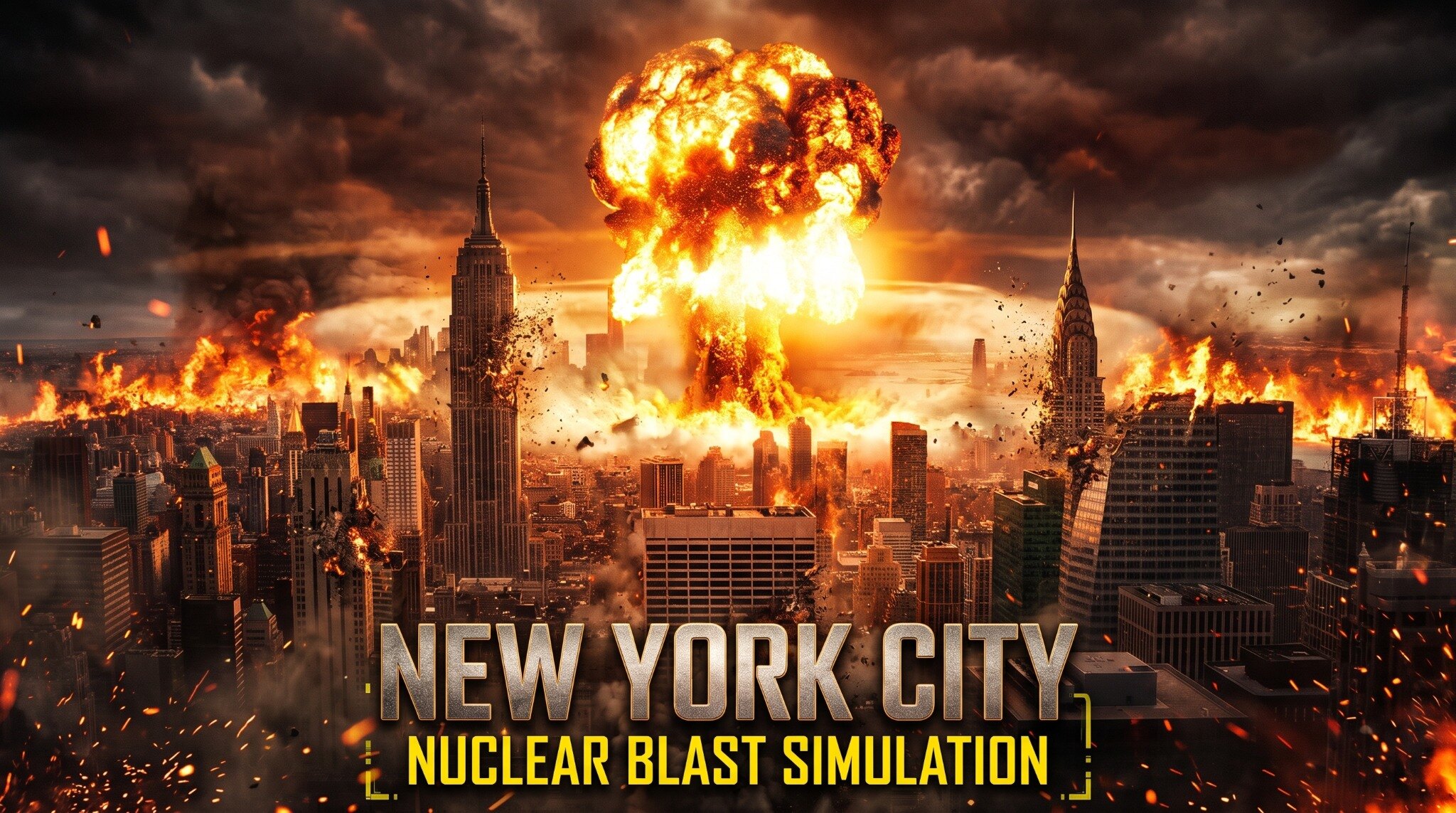
How quickly can a director put an impossible visual-effects idea on screen? Storyforge Imaginarium created this fictional New York City destruction sequence in a single production day—using AI-first filmmaking to visualize an event at the scale audiences associate with blockbuster spectacles such as Independence Day.
The production challenge: show the unfilmable
City-scale destruction is one of the hardest visual-effects assignments because the audience already understands the scale of the environment. A shock wave moving through an anonymous corridor is one problem. A pressure wave moving between recognizable Manhattan towers is another. The buildings establish distance, proportion and geography; every failure in motion becomes easier to see.
This sequence moves through Times Square, One World Trade Center—also known as Freedom Tower—Trump Tower and street-level Manhattan canyons. The creative goal was not simply to generate explosions. It was to direct a chain of readable cause-and-effect images: the initial flash, the expanding pressure front, the interaction between the wave and the built environment, structural failure and the delayed movement of smoke, glass, dust and debris.
Nanosecond-style bullet time gives the audience a point of view
At normal speed, an extreme event becomes a flash followed by chaos. Bullet time changes the storytelling proposition. It lets the director isolate the instant when energy reaches a façade, moves around a corner or forces material into the street. The film stretches a fraction of imagined time into a sequence the audience can study.
That temporal design creates a progression: distant skyline scale, landmark recognition, closer structural interaction and finally street-level pressure moving between buildings. Each shot answers a different visual question while advancing the same event.
Directing the pressure wave as a character
The most important element is not the fireball. It is the movement traveling away from it. The pressure front needs a clear origin, direction and consequence. At street level, the wave should appear constrained and redirected by the urban geometry rather than behaving like a generic cloud placed over the image.
An AI-first director still has to specify visual causality: what moves first, what remains stationary for scale, where the energy travels, how the camera observes it and what continues moving after the initial force passes. Without that structure, generative video can produce energetic imagery that lacks physical storytelling.
Landmark continuity turns spectacle into a sequence
Recognizable locations create continuity obligations. Times Square has a dense vertical field of screens and signage. One World Trade Center has a distinctive taper and spire. Trump Tower is defined by its dark reflective façade and Fifth Avenue presence. The production must preserve enough architectural identity for the audience to understand where it is, even as the scene transforms.
The landmarks therefore function as more than scenery. They become visual anchors against which speed, distance and deformation can be judged. The objective is not survey-grade architectural reconstruction; it is coherent cinematic geography.
What an AI-first pipeline changes
A conventional version of this concept could require extensive previs, environment builds, asset modeling, texturing, rigging, destruction setups, fluid and particle simulation, lighting, rendering and compositing. Experienced teams might spend weeks or months developing the sequence before it reached a polished editorial form.
The AI-first approach collapses the distance between concept and moving image. A solo filmmaker can establish the dramatic thesis, test views of the event, reject weak physics, redirect camera language and assemble a finished proof of concept within a day. That does not make every frame infinitely controllable, and it does not eliminate iteration. It changes when the creative team can see the idea.
Speed is valuable because it improves decisions
The strongest business case for AI-first visual effects is not merely lower cost. It is earlier clarity. A director, producer or studio can evaluate whether a sequence feels frightening, overwhelming, legible or emotionally empty before committing to a long production path.
A finished-looking proof of concept helps answer practical questions:
- Does the audience understand the geography?
- Is the event large enough to feel cinematic?
- Which landmark shots deserve further development?
- Does the pressure-wave behavior communicate force?
- Should the final sequence use AI-native production, traditional VFX or a hybrid pipeline?
Where traditional VFX still matters
Traditional simulation remains essential when a production needs tightly repeatable physics, exact engineering parameters, long revision chains, specific asset behavior or seamless integration across hundreds of shots. AI-first visualization serves a different and increasingly valuable function: rapidly discovering the shot, proving the concept and sometimes producing the final cinematic image when the output meets the director’s standard.
The practical future is hybrid. Use AI to make ambitious ideas visible early. Then choose the production method that best serves control, schedule, budget and the story on screen.
The real deliverable is creative confidence
This film demonstrates a production capability that would have been inaccessible to most independent directors only a short time ago: a recognizable city, multiple landmark perspectives, extreme environmental effects, fluid-like pressure movement and coherent editorial escalation—conceived and completed by one AI film director in a single day.
That speed does not replace directing. It increases the number of serious ideas a director can test. The differentiator is still judgment: selecting the right image, maintaining scale, preserving continuity, designing sound and knowing when spectacle is serving the story.
Hollywood Quality. Silicon Valley Speed.
Storyforge Imaginarium develops AI-first cinematic proofs of concept, book trailers, music videos and visual-effects sequences for projects that need to move from idea to screen quickly. The goal is not to generate more footage. It is to make the decisive image sooner.
Watch the film: New York City Nuclear Blast Simulation on YouTube.
Discuss a project: Studio@StoryforgeImaginarium.com
← Back to The AI Showrunner — Director’s Brief
Get the AI Showrunner Brief
New articles on AI filmmaking, book-to-screen, and production. No spam — just the brief when something new goes up.