

How an AI Showrunner Manages a Film Like a Software Release
The Fourth Watch case study shows how Storyforge Imaginarium plans shots, manages dependencies, and gives sponsors a clear view of what’s ready for approval.
In Fourth Watch: The Currency Cliff, a cut from the snowy Liberty Rail yard to the inside of Sentinel One has to feel like one continuous moment. The light through the cab windows has to belong to the same morning. The locomotive has to look like the one we just saw outside. And when Sam Granger speaks, his performance has to carry into the next shot.
Each of those details is a creative decision. Each is also a dependency. If we change the exterior lighting after the cab sequence is approved, we can reopen footage, color, and editorial work that already looked finished. That’s where my experience in technical delivery comes into film production.
My work on projects for Amazon, Microsoft, Ford, Hotels.com, and Aristocrat Technologies gave me a foundation for managing large, highly visible projects. I learned to translate client specifications into a delivery plan, coordinate creative and technical work, and surface schedule, scope, and budget decisions early enough to protect the commitments we made. I earned the PMI Agile Certified Practitioner credential earlier in my career and bring those practices to AI-first film production.
Build the schedule around what can hold up delivery
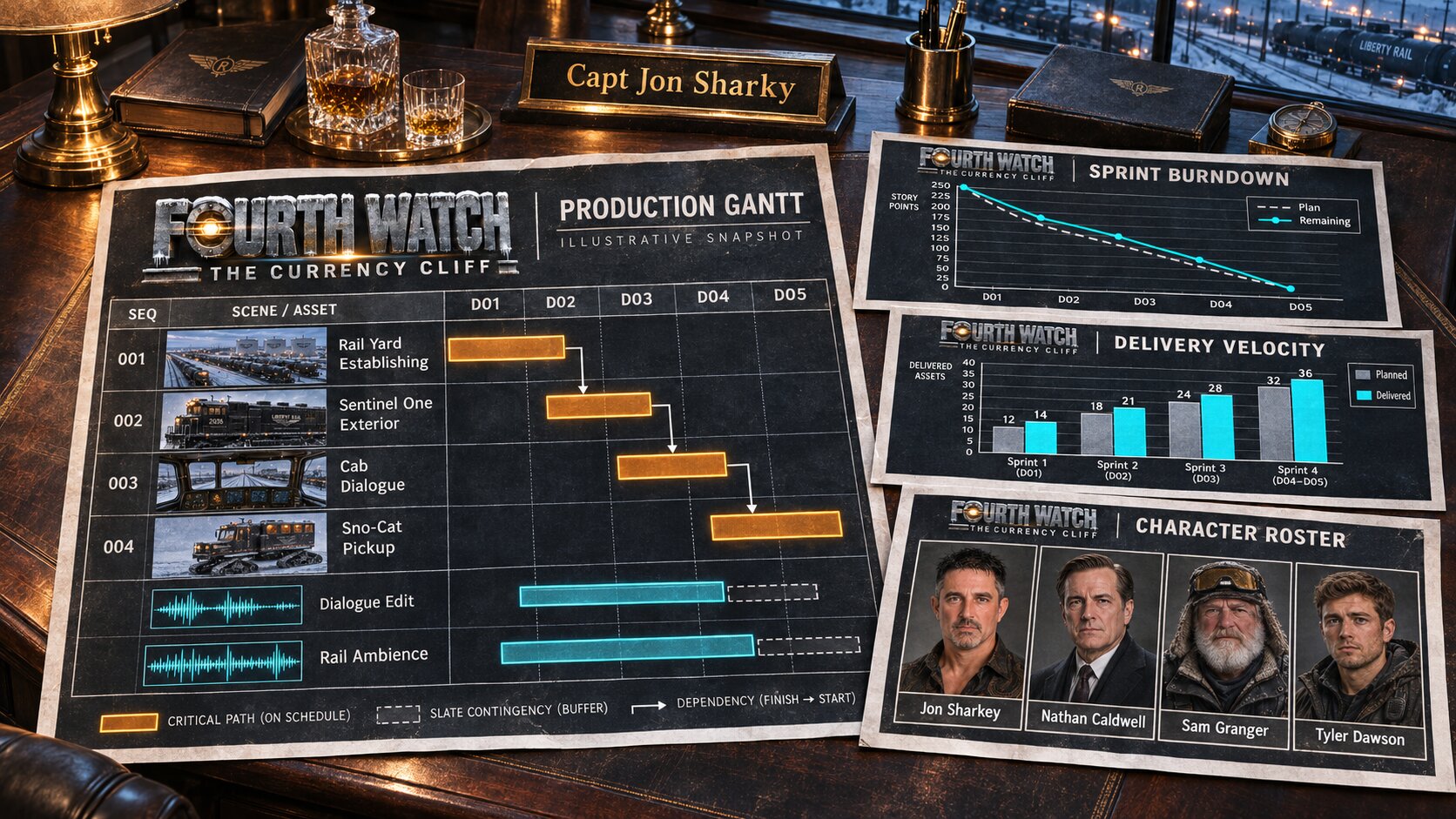
I start with a shot and sequence backlog in a tracker such as Jira. Each ticket has an owner, a due date, the approved references, the deliverable, and the criteria it must meet. A Gantt chart gives the team a different view of that same work. It shows what can run in parallel, what’s waiting on approval, and which delay can move the delivery date.
For a Fourth Watch episode, locking Sentinel One’s design and the winter exterior look gives the team a reference for generating the cab coverage. Rail ambience can develop in parallel. The final dialogue edit depends on the approved performance and cut timing. If a shot needs another pass, the schedule shows where a pickup can fit and where I need to escalate a decision.
Use the daily stand-up to protect the next review
I run a short daily stand-up around three questions. What’s ready to review? What’s blocking the next handoff? What can we commit to before tomorrow?
A blocker gets an owner and a decision time. If the first cab pass has the right performance but the window light feels wrong, I can give the producer a specific note, preserve the take as an editorial reference, and decide whether to revise the shot or fix it in finishing. The team leaves knowing what to do next and when we’ll look at it again.
For external stakeholders and project sponsors, I use a review cut and a short decision log. Each review identifies the version, the question we need answered, who can approve it, and when the decision is due. A sponsor who has five minutes can see the actual shot and make the call that keeps the episode moving.
Track accepted work and forecast the cost to finish
A sprint burndown shows how much estimated work remains. A velocity view shows how much work has met the acceptance criteria across comparable sprints. I use those views to forecast capacity. For example, if several shots are waiting on the same look approval, adding generation capacity won’t clear that queue. A focused review with the right approver might.
I also track actual spending, committed costs, and the estimate to complete. That includes producer and editorial time, generation and finishing costs, and contingency. If a new request changes the scope or schedule, I spell out what it will cost, what it will move, and what we can swap out. The sponsor can decide before the team commits the extra work.
Put quality checks before the handoff
A generated clip becomes a production deliverable when it works in the cut. I review performance, character and wardrobe continuity, lighting, and color against neighboring shots. Before final sign-off, I check sound, sync, and the agreed technical specs, including frame rate, dimensions, and export format.
For an ongoing microdrama, that discipline carries forward. Approved character, voice, and environment references give the next episode a starting point. The team keeps a record of what passed, which notes changed the cut, and which estimates need to improve. The next episode starts with more of the world already defined.
At any review, a Storyforge production partner can see what’s approved, what’s at risk, what it will cost to finish, and which decision moves the film forward. That’s how I manage production to the client’s specifications, schedule, and budget.
Watch the Fourth Watch trailer
Watch the Fourth Watch trailer on YouTube or explore Storyforge’s production process.